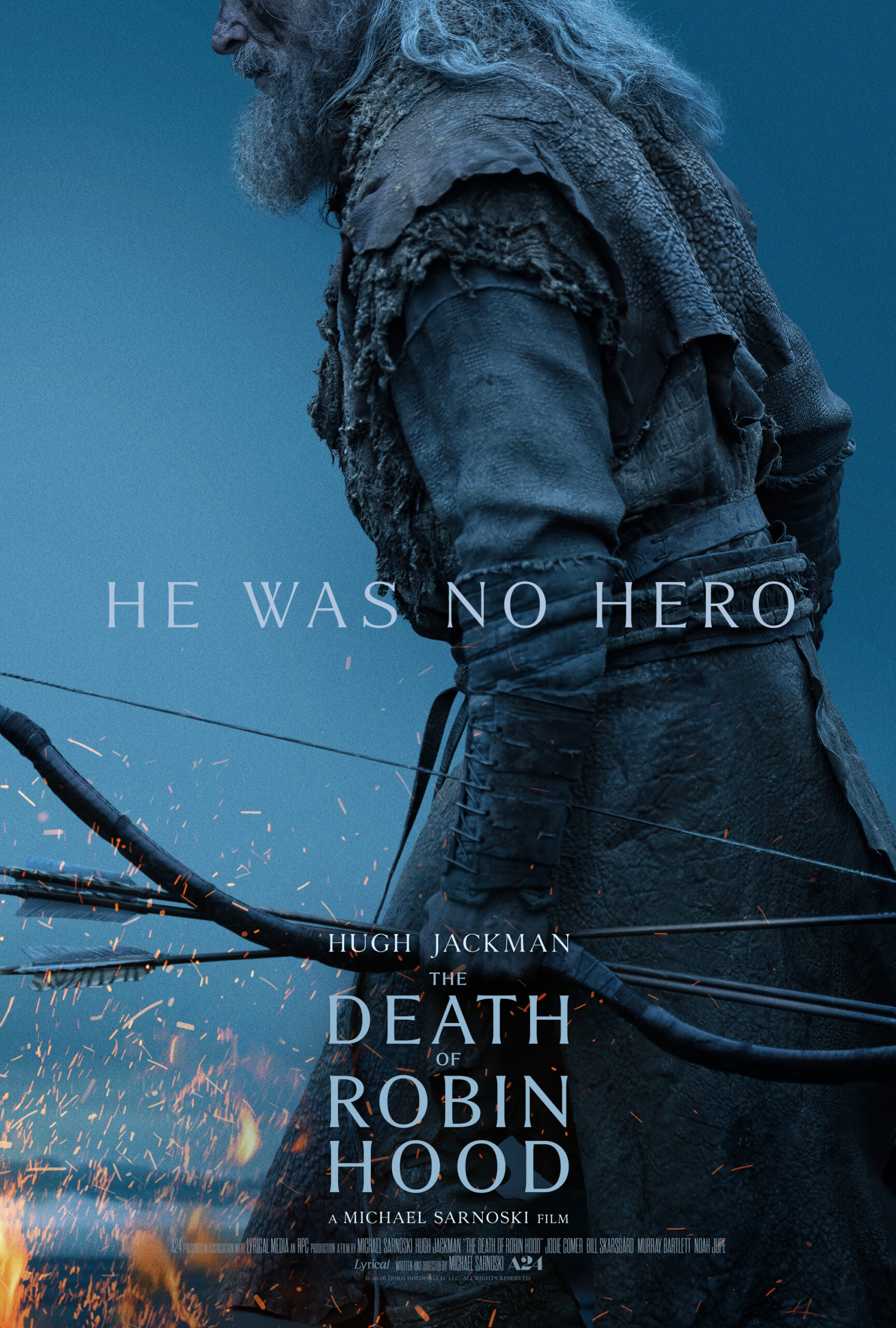
The Death of Robin Hood
Review by Mark Woodring
Another year, another deconstructed hero. This one draws on all kinds of “source material” to cobble together it’s narrative.
From ancient ballads of Robin Hood to a Longfellow poem, and yes, even to the exceptional film Logan, this one is shameless in its appropriation.
Oh, and it’s got Hugh Jackman in it, so the Logan comparisons are unavoidable.
**NOTE: You can read Mark’s review below, then listen after he and Ryan get a chance to discuss the film further. Remember, though, you can listen to all our discussions of this and every other movie directly over on ACAST. Stay tuned.**

123 Minutes, Rated R
Written by Michael Sarnoski
Directed by Michael Sarnoski
Synopsis:
Grappling with his past after a life of crime and murder, Robin Hood finds himself gravely injured after a battle he thought would be his last. In the hands of a mysterious woman, he is offered a chance at salvation.
Writer/Director Michael Sarnoski has previously helmed PIG, which we like a lot, and A QUIET PLACE: DAY ONE, which we enjoyed, but it’s the weakest of the three films in that series. His choice of topics here, the legendary bandit/hero Robin Hood, could have been inspired.
But I have thoughts, and I’ll be interested to see how this film stacks up to the upcoming THE ODYSSEY, from Christopher Nolan, in terms of how the audience perceives changes in the mythology.
The Death of Robin Hood‘s opening quickly establishes that this “Robin Hood” is not the hero we know, but rather a simple bandit whose exploits have been mythologized through tales passed from person to person and town to town, embellished with every step and perhaps even hijacked by those with agenda beyond Robin’s own. He is old, tired, and still dealing with the fallout from the exploits of his younger day.
It is a pretty dark scene, that’s for sure. There is zero doubt about what kind of man Robin is.
What is clear through the early parts of the film is that Robin doesn’t exactly feel guilty about his former life, but who has grown exceedingly tired of living in a world in which he can know no peace. He longs for death, but will not simply surrender to it. Instead, he courts it, lastly by agreeing to assist Little John, who had gone into hiding and appropriated another man’s life (“Edward”), by rescuing his wife and daughter from men who discovered his true identity.
Though John/Edward’s wife, Margaret doesn’t survive the rescue, his daughter, Little Margaret, does, though Robin is gravely wounded.
Surviving that encounter against his wishes, Robin finds himself at an abbey run by a prioress purported to have healing powers (played by the always welcome Jodie Comer). John and Little Margaret cross the waters back to the mainland to flee, and Robin (calling himself Randolph, as he is still wanted by both the authorities and the families of his previous victims) is slowly brought back to health. He finds himself faced with the prospect of protecting Little Margaret after John/Edward is killed and she returns to the abbey to find him.
Thus far, we’ve cribbed from the 17th Century ballad “ROBIN HOOD’S DEATH” (the prioress) and LOGAN (most of the other plot points) (link).
The story continues, including an admittedly interesting sub-plot involving a leper and Robin’s own recollections about his past (one of my favorite bits), and Robin provides one final act of protection for Little Margaret before he resigns himself to life at the abbey, albeit after one final revelation.
In the end, Sarnoski’s script cribs Wadworth and alters “ROBIN HOOD’S DEATH” with Little Margaret (instead of Robin) launching an arrow out Robin’s window as he lay, finally, dying, perhaps with the sense of peace he claimed to be seeking.
The Arrow and the Song
By Henry Wadsworth Longfellow
I shot an arrow into the air,
It fell to earth, I knew not where;
For, so swiftly it flew, the sight
Could not follow it in its flight.
I breathed a song into the air,
It fell to earth, I knew not where;
For who has sight so keen and strong,
That it can follow the flight of song?
Long, long afterward, in an oak
I found the arrow, still unbroke;
And the song, from beginning to end,
I found again in the heart of a friend.
The idea that we cannot know the ultimate fate of that which we put out into the world, what impact it may have, “where it lands” if you will, is at the heart of The Death of Robin Hood‘s finale. It’s a good message, one we all might need to focus a bit more on. In this age of “fire and forget” action or commentary, the lack of aim is one of the greatest sins man can commit in the world.
So while I was ABSOLUTELY convinced that The Death of Robin Hood was simply going to be Logan 2.0, I’m still NOT convinced it wasn’t a huge influence on this narrative, bolstered by the influx of other material directly related to Robin Hood.
The fact I wound up enjoying the film at all is more a credit to the performances than the material.
Regardless, if we could consider The Death of Robin Hood to be The Death of the Deconstructed Hero instead, that would be great. It’s an idea which has outlived its impact and audience appeal.
The Death of Robin Hood arrives in theaters Jun 19 and stars Hugh Jackman, Jodie Comer, Bill Skarsgard, Faith Delaney, Noah Jupe, and Murray Bartlett.
And remember, if the BEST thing you can say about a movie is that it’s “visually stunning,” then they’ve done something wrong.
Please don’t forget to LIKE, SHARE, and FOLLOW us on:
- Facebook (@vsmoviepodcast)
- X (@vsmoviepodcast)
- Instagram (@visuallystunningmoviepodcast)
- Threads (@visuallystunningmoviepodcast)
- YouTube (@visuallystunningmoviepodcast)
- Don’t forget to SUBSCRIBE to our audio wherever you listen to podcasts (https://shows.acast.com/vsmoviepodcast)
And please, if you like what we do, consider helping us keep on entertaining you. You can use this handy link:
Or, you could check out the merch in Our Store:
Not only will you be helping us out if you pick up some merch, you get cool stuff to wear around (including the coveted WTFWT? logo!)